Your vehicle’s automatic transmission is one of its most intricate and hard-working mechanical systems. Composed of hundreds of precision-engineered components working together, it transfers power from your engine to the driving wheels seamlessly. However, because modern gearboxes handle intense hydraulic pressures and extreme friction, regular transmission servicing is essential to prevent costly breakdowns and maintain smooth gear changes.
Operating from Mona Vale since 1994, Peninsula Auto Clinic has provided comprehensive vehicle maintenance across the Northern Beaches for over three decades. Understanding what goes into a professional automatic transmission service helps you protect your investment and keep your vehicle performing at its best.
Why Automatic Transmissions Need Regular Servicing
Unlike engine oil, which primarily lubricates and cools, Automatic Transmission Fluid (ATF) performs multiple complex tasks simultaneously. ATF serves as a hydraulic fluid to actuate gear shifts, operates the torque converter, cools internal clutch plates, and lubricates planetary gear sets.
Over time, continuous heat cycles degrade the chemical additives within the fluid, reducing its ability to protect moving parts. Fine metallic particles and clutch friction material naturally wear off and circulate through the system. If left unserviced, this contaminated fluid causes internal friction, slipping gears, delayed engagement, and eventually total gearbox failure.
Key Steps Included in an Automatic Transmission Service
A complete automatic gearbox service involves far more than simply topping up fluid levels. A thorough service at an experienced workshop includes the following critical steps:
1. Initial Inspection and Road Test
Before bringing the car into the service bay, a technician conducts a road test to evaluate gear shifting quality, torque converter lockup, acceleration response, and any unusual noise or vibration. Diagnostic scan tools are also attached to check for stored fault codes within the Transmission Control Module (TCM).
2. Draining Old Fluid and Removing the Transmission Pan
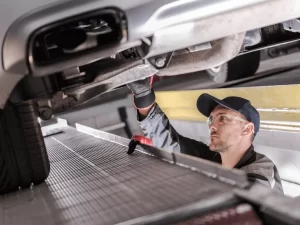
The vehicle is raised on a hydraulic hoist so technicians can safely drain the old, heat-degraded transmission fluid. The lower transmission oil pan is unbolted and removed to inspect the internal sump area.
3. Cleaning the Pan and Collecting Magnet Inspection
Most transmission oil pans feature built-in catch magnets designed to attract ferrous metal particles. Mechanics examine these magnets closely; fine metallic slurry is normal wear, but larger metal flakes or brass filings indicate severe internal gear or bearing damage.
4. Replacing the Internal Transmission Filter or Strainer
The old transmission filter, which traps circulating debris before fluid re-enters the hydraulic valve body, is unbolted and discarded. A fresh, high-quality filter gasket and element are installed to ensure unrestricted fluid flow.
5. Fitting a New Pan Gasket and Re-Torquing Bolts
To eliminate future fluid leaks, the pan sealing surfaces are thoroughly cleaned and prepped before a new pan gasket is installed. Pan bolts are torqued strictly to manufacturer specifications to prevent warping the pan flange.
6. Refilling with Premium Manufacturer-Specified ATF
Not all transmission fluids are the same. Modern automatic gearboxes require precise fluid formulations (CVT, dual-clutch, or multi-speed ATF) matched to exact friction tolerances. Fresh fluid is added to the exact fill level at specified operating temperatures.
Local Northern Beaches Driving Factors that Accelerate Fluid Breakdown
Driving conditions around Mona Vale, Narrabeen, and Warriewood subject automatic gearboxes to increased thermal stress:
- Stop-and-Start Traffic: Daily commuting in heavy traffic along Pittwater Road or Barrenjoey Road causes frequent gear hunting and continuous torque converter slipping, generating high internal heat.
- Steep Coastal Inclines: Navigating steep hills across the peninsula places high torque demands on automatic clutch packs.
- Salty Coastal Moisture: High atmospheric humidity and salt air can accelerate external casing corrosion and compromise pan gaskets over time.
Signs Your Transmission Needs Attention
If you experience any of the following symptoms, your vehicle should be inspected by a professional mechanic immediately:
- Sluggish or delayed gear engagement when shifting into Drive or Reverse.
- Harsh, clunky, or erratic gear shifts during acceleration.
- Engine revs spiking between gear changes (gear slipping).
- Unusual whining, humming, or buzzing noises coming from beneath the floorboard.
- Red or dark brown fluid puddles forming beneath your parked car.
Complete Mechanical Care and Driveline Servicing in Mona Vale
At Peninsula Auto Clinic, our award-winning workshop provides professional automatic transmission servicing, clutch replacements, fluid flushes, and comprehensive mechanical car repairs. Our qualified mechanics utilise advanced diagnostic technology to keep your vehicle running smoothly and reliably.
We proudly look after local drivers across Mona Vale, Narrabeen, Warriewood, and surrounding Northern Beaches communities.
Book Your Transmission Service Today
Protect your drivetrain and restore smooth gear shifting to your car. Call the friendly workshop team at Peninsula Auto Clinic today on 02 9999 2553 or book your service online using our contact page.